Showing posts with label monochromator. Show all posts

Wednesday, June 11, 2014

Bausch and Lomb light source numbers

Bausch & Lomb part numbers, discovered from various sources.

Insert below is a available for download.  I'll update the csv and google docs files as I get a chance to upload them

csv file

google spreadsheet

first column is divisions / mm for gratings.  heading got cut off.

Includes raw gratings, monochromators, light sourcs and power supplies.


Friday, January 24, 2014

Pyrolytic Graphite Monochromator


http://www.2spi.com/catalog/new/hopgsub.php

Use as graphite monochromators:

The HOPG offered by SPI Supplies, especially the SPI-1 and ZYA grades, are reported to diffract x-rays and neutrons with a higher efficiency that any other material. For x-rays the intensities are increased up to five times greater than what would be possible with the lithium fluoride crystal it would replace. A singly bent focusing monochromator using these highest quality grades of HOPG, i.e. those with the smallest mosaic spread, result in intensities three times that of LiF at the same resolution.


http://pd.chem.ucl.ac.uk/pdnn/inst1/monoc.htm

For X-ray and neutron analysis. Size: 25mm x 25mm x 2mm. Grade ZYA Flat. 


Saturday, December 28, 2013

Bausch & Lomb Deuterium Source power supply (acts 2 and 3)

Another deuterium source showed up on epay and the seller took my offer.  I had three power supplies and one head, now I have 3 heads!  When it rains it pours.

These are pretty rare, and this is one of the best units for UV monochromatic work that is available.  other deuterium sources are scrounged from UV-VIS devices or AA spectrophotometers which have been broken up.

Of course you can buy one new and pay lots more than this but the newer units are not as nifty as this one.


Lamp with vent stack removed


exit hole, with filter clips


power supply connector

This unit is pristine

Saturday, March 3, 2012

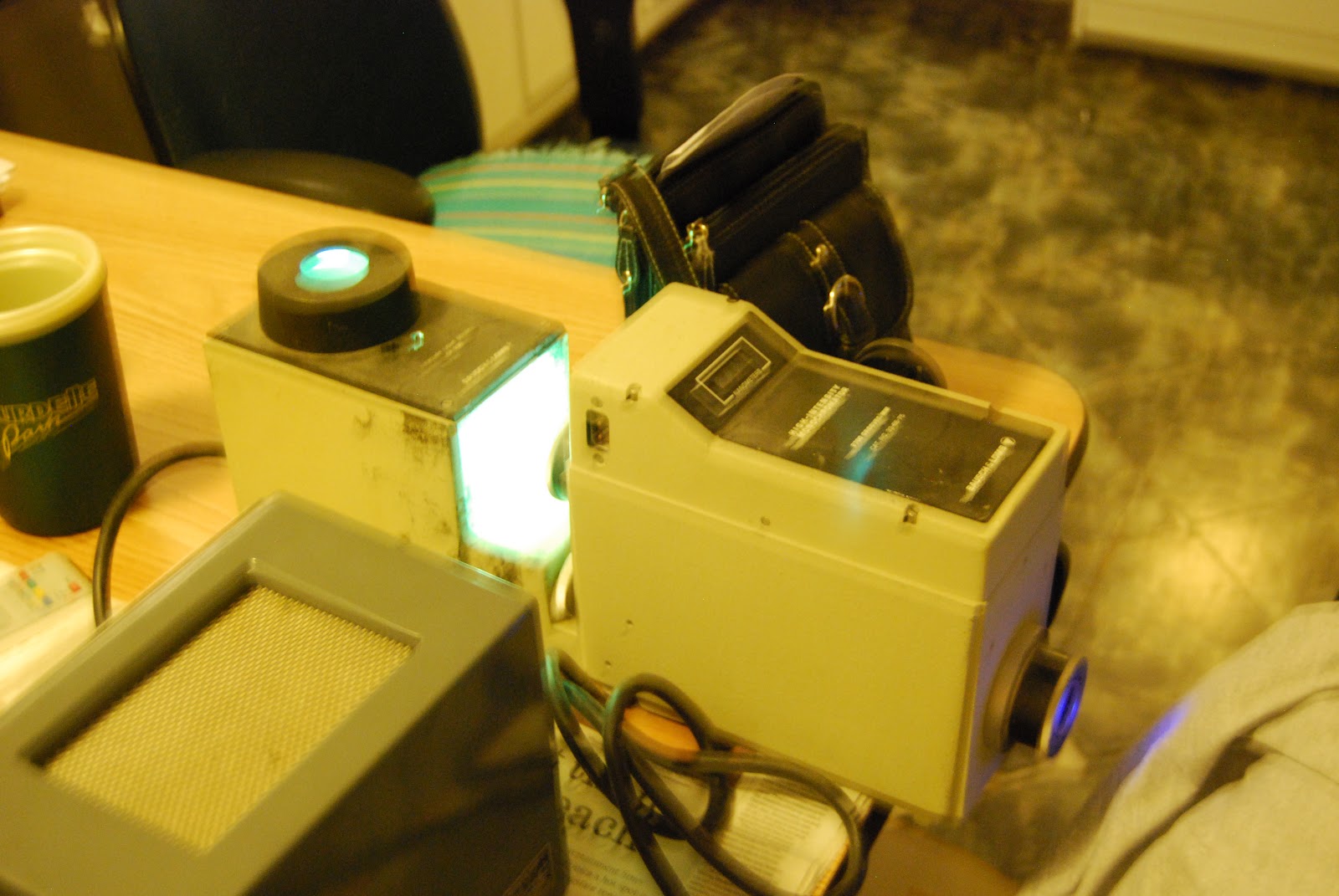
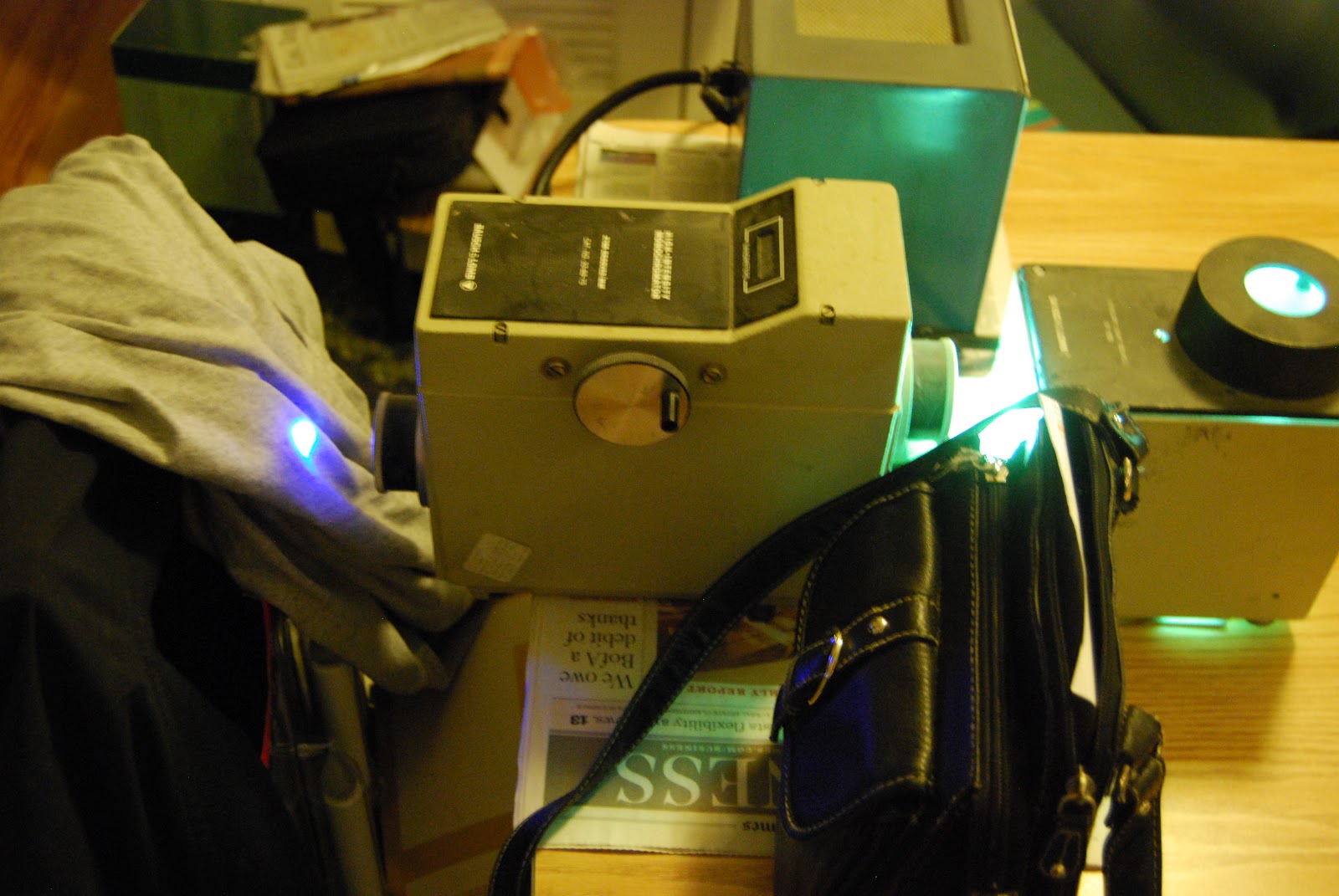
Bausch and Lomb Mercury Arc UV source and monochromator

This is a Bausch and Lomb High Intensity Monochromator with an SP-200 UV Mercury arc source.

Monochromator is catalog # 33-86-75.  Grating has 2700 lines / inch.

Operating, output set to 170nm, flash photo

 Lamp operating full intensity, output set to 300nm
 Output set to 300nm
 Operating full intensity 300nm
 Power supply SP-200
 Power supply SP-200
 Interior of source, showing lamp and choke assembly
Choke / concentrator has quartz optics, two elements
to concentrate beam from Lamp.
 Closer up to Lamp
Lamp envelope.  arc starting electrode is
on opposite side of the envelope.  There is only
the high voltage connected to the top and
bottom.  Other arc starting electrode on
opposite side has no connection, but is
open to air to allow arc at lower starting
voltage (I think)

Wednesday, August 10, 2011

Bausch & Lomb Deuterium Source power supply

I got the rest of the deuterium source in an auction today.  Now have a functioning source.

This is the head, already covered in an earlier entry


 Supply front.  It has an on off switch and an ammeter to indicate primary high voltage draw.  Deuterium lamps must be started with a heater and a spark, so the trick of these supplies is to kick that w/o damaging the lamp.  The yellow light comes on for about 5 or so seconds to fire the lamp, and the arc stabilizes in about 5 more to the usual "uv" violet glow.
 rear of the display 120v 60hz, 160 watts cat number 33-86-35

 from the top of the source housing
 bottom of the housing type also 33-66-35
 output aperture from supply (operating, but flash and exposure doesn't show uv)
 uv purple, available light shot.

 collimation lens system.  since it is UV, must be quartz optics


Next stop, collect the monochromator from stash and test out the thing.  Unfortunately, I don't know how far down my Ocean Optics spectrograph goes.

Sunday, April 24, 2011

Bausch & Lomb Monochomater Deuterium UV Lamp source

This provides an alternate source for the UV monochromator head.  There is also a UV source which is a Mercury lamp powered unit.

I now have all three of the optical units, several of the Tungsten lamps, and this lamp unit.  Now to find out if it will work with any of my power supplies.  I do have a source with P/S which has both a mercury lamp and a deuterium lamp, but it is not B & L.  Also it does not have a power supply for the mercury lamp.

The apples were tasty too.


Saturday, December 18, 2010

EG&G / Instruments SA Inc. Spectrographs

I just acquired three spectrographs off Epay, and got them.  I originally thought they had the 1x1024 or 1x256 EG&G sensors internally, but now am seeing that they have a much more sensitive system with cooling provisions, probably with TE cooling from the looks of them.  I am not going to tear them up any further until I can research them further to see if I can get them working.

The have the following info on the Spectrograph body

Serv P/N 603461 Rev A
MFG P/N 604538

Ser# 106479
Instruments SA, Inc.

The EG&G sensor has the following
SC0564NNN-911
S/N R984042A

ABD MFG P/N 4306153 Rev A

Here is the original auction listing text:

It came out of a DNA Genome Mapping Machine, they used Air cooled Argon lasers and Hene lasers to cover a wide spectrum of the Human Gene ohm. It came with a bunch of Argon lasers we bought 5 years ago from the Silicon Valley Scrappers. I can’t use them they have a thermal chilled CCD in heavy gold plate housing. Also, there is a very fine line grating in the rear of the housing as seen in the picture of one that I took apart

Here are some photos:
 Above is a diagram of the spectrograph
 The grating.  It is about 3 1/2" or 4" in diameter.  Probably not ruled, but replica. 
 Sensor is in gold box.  Probably vacuum charged from the looks.  Also will guess quartz window. 
 Another shot of the image sensor.  If you look there are gold on ceramic traces internally.  I looked at an angle off to one side and there are gold pads on the back below the sensor.  Probably insulated feedthrus from the back for the signals.
 Another angle on the sensor
 The signals come out on a DB37 and thru the ribbon cable on the left.  It will be nice if I can find anything out about these.
 The cooling array on the rear.  The image sensor is on the right at an angle
 Profile view of the optical system.    Hole in the upper right allows the diversion mirror to be adjusted from outside the system.  I assume it would be tweaked until the best beam is on the image sensor
 This is the collimation system.  Slit is at the right, then probably a couple of choke lenses in the drift tube. 
 The plate visible to the upper left is a block that goes between the optics and the image sensor module.  The image sensor is probably bought out as a unit from EG&G and has nothing to do with the optics the vendor attached it to.  The plate has a peep site that allows one to view the image sensor illuminated by the spectrum, which is pretty cool.  It is a small hole covered with a plastic cover.  The angular hole at the right side of the plate is the aperture which has a view of the image sensor.  there is an eyepiece lens and mirror in this block of aluminum.